Podcast: Play in new window | Download
Subscribe: RSS
While Halloween brings out plastic skeletons and novelty spiders, the real threats lurking around our homes are much less festive. In this special seasonal episode of the Peskies Pest Control Podcast, industry pros Michael and Travis discuss the importance of pest control as a vital pillar of modern sanitation, agriculture, and public safety. Discover the real-world history of rodent-borne plagues, the truth about destructive pests like termites, and why leaving your carved pumpkins out past October 31st is an open invitation for an infestation.
Podcast Transcript:
Michael: Uh, what are you doing for Halloween?
Travis: [sighs] Dragging myself and my family around a neighborhood, [laughs] I’m sure. What about you?
Michael: I mean, I’m—I’m excited about it. What are you dressing up as, Travis?
Travis: I—I do not—
Michael: You sound so dull about it.
Travis: I do not dress up for Halloween. There’s a lot of—there’s a lot of people I know out there that do the whole family costume dynamic, you know, like I’ve seen, like the Disney movie, The Incredibles, or whatever. [laughs] You know, they’ll all dress up as The Incredibles or something like that.
Michael: I am offended. I’m offended, sir.
Travis: Oh, is that—is that your—is that your plan for this year?
Michael: Well, I’ll—I’ll tell you my story after you—after you continue going on.
Travis: No, uh, we’ll—we’ll venture out somewhere. Um, usually there’s a neighborhood not far from my house that we go to cuz we don’t live in a neighborhood, I guess. So, yes, we are some of those people who [sighs] go and intrude on other people in other neighborhoods. Um, [chuckles] but anyway, we’ll—we’ll probably go walk that. I’m sure my daughter will be some form of princess because she’s in her princess era right now, and my boys really are—are too cool to dress up, honestly. They’re—they’re—they’ve reached that point now where they’re too cool to do anything like that now.
Michael: No—no masks or anything?
Travis: Not really.
Michael: Oh, wow. Well—
Travis: Boring, like me.
Michael: Well, mine was going to be themed. We were going to do Toy Story. Um—
Travis: Oh! So you feel targeted [laughs] because of my—
Michael: That’s why I’m so—I’m so offended, sir. Um—
Travis: I’m sorry.
Michael: [clears throat] No, it’s completely fine. Uh, before children, I kind of felt the same way, but again, you know, my children are a little younger than yours and and all that, so, um, the magic and wonder. But, uh, [clears throat] we’re doing—we were going to do Toy Story. Now we’ve cut it in half to where my, uh, my oldest wants to do Toy Story, so I am going to be a blow-up Buzz Lightyear, and he is Woody. And then my youngest is a skeleton, and my wife’s going to be a skeleton cuz my—
Travis: How—how big of a Buzz Lightyear will you end up being? [Michael laughs] I’m going to need photos of this sent to me.
Michael: It’s pretty awesome. It’s pretty awesome. It’s, uh, it’s a full blow-up, and it’s—but I can still carry my children. So, like, I’ve never been able to, you know, when they were younger, I couldn’t have a blow-up because I always had to, like, walk them around. This one, you can still maneuver with your kids.
Travis: So is there like—like a inflatable six-pack, like on your chest or something like that? Is it—
Michael: Oh, no, you’re like a Michelin Man. You’re— [Travis laughs] It’s very—very comical, but my son loved it, so, you know.
Travis: The things we do for our children.
Michael: That’s right. Well, we are—we are definitely getting off on a spin on on what we were not going to talk about, but let’s talk about, you know, the whole—Halloween’s coming up. You know, Happy Halloween. I know you’re you’re not big on it, but my wife is big on just decorating and and colors—
Travis: Oh no, no, no. Don’t get me wrong.
Michael: Oh, you do decorate your house? I forgot about that.
Travis: We have decorations. Yeah, there’s a giant inflatable ghost in the yard, and there’s, like, green and purple and orange LED lighting.
Michael: I forgot about the LEDs.
Travis: No, no, we—there is decorations. Um, just, it’s the whole dressing up, trick-or-treating thing that I I just don’t really care about, you know.
Michael: Gotcha.
Travis: Could stay home, [laughs] watch a movie or something.
Michael: I like staying home, too. Um, all right. So, what’s the scariest bug, like, you can think of that comes to your mind? The scariest thing that you have come across in your career?
Travis: [sighs] Um, I mean, I can definitely mention a couple of creepy bugs that will catch you off guard if you’ve ever ran into them. Uh, I wouldn’t necessarily say that they are, you know, that that the one in particular that jumps into my head is Halloween-themed, but it definitely is kind of grotesque looking. Uh, and if you were to run across it, it might creep you out. So, you know, everyone obviously with Halloween thinks of spiders and snakes or scorpions or rats or mice or or whatever. But I remember when I ran across—and maybe you know what this is—a dobsonfly.
Michael: Oh god, yeah. They’re They’re things of nightmares.
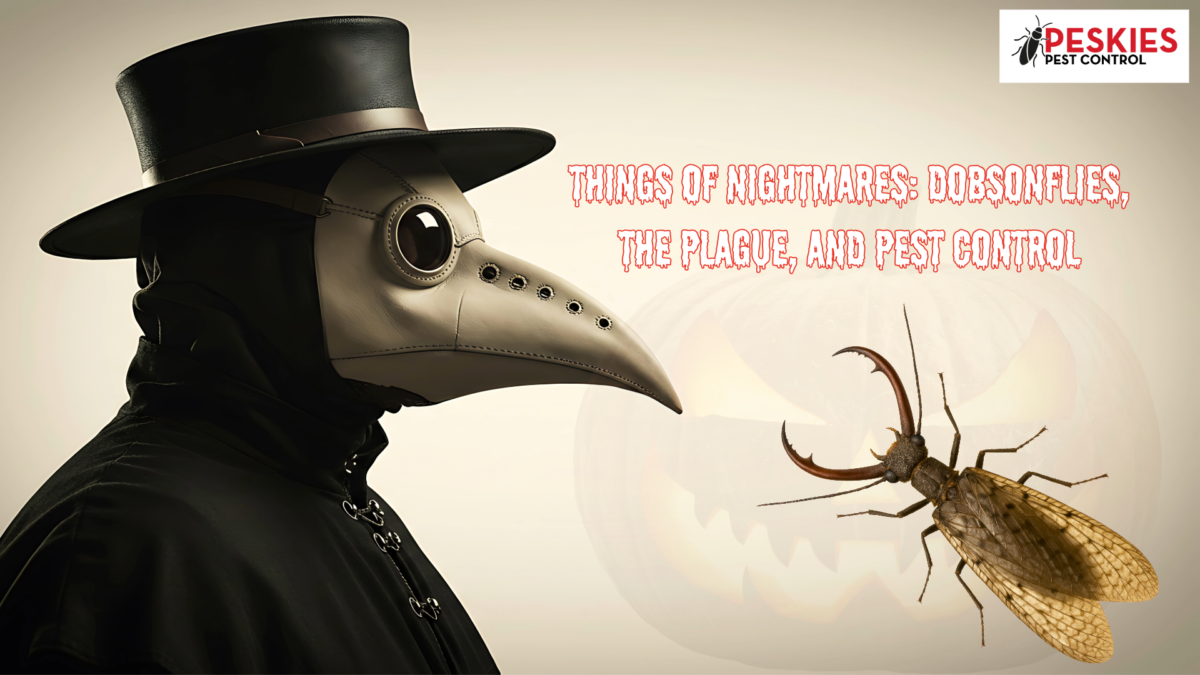
Travis: Yeah, if if uh if you’re listening and you have never seen a dobsonfly, Google it. [Michael chuckles] Just Google it. It is like this weird looking creature with wings and like looks like these giant pinchers on like the front of the body on the head. And, uh, yeah, it’s It’s pretty pretty creepy looking if you don’t, you know, if you don’t know what it is and you just come across that, but they actually get pretty large.
Michael: So what is the creepiest thing that you’ve come across?
Travis: That. I’ve actually come across one.
Michael: Oh, oh, I’ve never seen one. I’ve I’ve picked up—
Travis: Yeah, I think they’re more—from what I understand, they’re more common closest to water sources, so—
Michael: Oh, like lakes and—
Travis: Lakes, streams, you know, that kind of thing. But yes, I actually have come across one in the wild, if you will, and I was out doing pest control on—I want to say I was out in Wetumpka at a commercial property going around the outside, and I came across it, and I did not know what it was. And, um—
Michael: What did you think when you saw it?
Travis: I was like, holy crap. What is that? Like, what laboratory did that escape out of, right? [laughter] Um—
Michael: A mayfly and a a a praying mantis.
Travis: Like, had a baby or something.
Michael: Got together.
Travis: There’s an app that you can download on your phone called Seek. Uh, I think it’s by iNaturalist or something like that, but it’s called Seek, and you can take a picture of an insect, um, an animal. You can take a picture of like a plant, and it will, assumingly, use AI to identify exactly what it is, and that’s where I learned what a dobsonfly was cuz I had never seen one to that point. So, yeah, that has to rank um, uh, up on the top of my list for unusual, more scary-looking insects, especially if you don’t know what it is. You feel like it could like eat your finger off or something.
Michael: Mine’s an earwig. [laughs]
Travis: Is it because of the old wives’ tale about the earwigs?
Michael: I don’t know. It’s the big ones. Like, you’ll see the small ones in the, um, in the mulch or something, but a lot of times when you’re checking, you know, the Trelona stations or something or or you’re putting them in the ground, you’ll you’ll see those really big ones, and they just, I don’t know. I just, if they were a foot tall, they’d be they’d be a force to to run into.
Travis: I’m not going to lie. Some of those earwigs get extremely large.
Michael: And then second would be just any centipede, millipede. I mean, they’re just kind of gross to me. I don’t like them.
Travis: Yeah, but some of them are a lot of them are quite, you know, helpful. Um, least some.
Michael: Yeah, but they’re— Some are poisonous. I just, I don’t know, they’re creepy. They you always—and and uh they go pretty well with Halloween-themed. I feel like, you know, um, I don’t know, I’m going back to the ’90s, but Aaahh!!! Real Monsters, you know, [Travis laughs] something like that.
Travis: Well, with with it being Halloween-themed, we we can also mention this, too. I mean, everyone, you know, decorates and all that, and a lot of times there’s rats and mice. And, um, but pop quiz question for you: for for years and years ago, back when the plague hit, since since we’re since we’re talking about Halloween, what was the cause of the spread of the plague in Europe?
Michael: What they thought the cause was or what the actual cause was?
Travis: What the actual cause was.
Michael: The actual cause was the flea.
Travis: Spread by what?
Michael: By the rodents?
Travis: Yep, exactly.
Michael: Yeah. Yeah, that was the—that’s what they thought. But didn’t they think it was the the rodents and they started killing rats left and right and all that kind of stuff?
Travis: Well, it was it was fleas that were spread by infected rodents.
Michael: How would that have sounded if I got that wrong?
Travis: I would have cut it out of the podcast [laughter] and started over.
Michael: No, sir. This is This is completely live and unscripted.
Travis: Um, so, they call, you know, that was from like 1346 to 1353, so just shy of, um, 10 years, almost, that Europe did this, and there were like 50 million deaths from the plague, and to put that into perspective, that was 50% of the population in Europe.
Michael: Oh, I know. It wiped out, I mean—
Travis: Right. But the plague was a bacterial disease or infection that was caused, spread by fleas from infected rodents, and, you know, of course, fever, aches, swelling, coughing, difficulty breathing, vomiting, nausea, all and and and, you know, just death, too, at the end of that.
Michael: Instant.
Travis: [chuckles] So, um, but go back, since we’re talking about Halloween, and there will be There will be people that dispute this, and they say that the nursery rhyme “Ring Around the Rosie” has nothing to do with the Black Plague or the plague.
Michael: I think it does.
Travis: I fully, truly believe that the lyrics to that nursery rhyme have everything to do with the plague.
Michael: Well, I think most—
Travis: Look at the lyrics.
Michael: Well, look at most nursery rhymes in general. They’re not They’re not pleasant. [laughs]
Travis: “Ring, Ring around the rosie,” okay, so we’re we’re talking about the skin condition that develops from this, the the rash and and all that. “Pocket full of posies,” to ward off anything, you know, to ward off the plague. “Ashes, ashes,” they they burnt crap up trying to get rid of it.
Michael: Mhm.
Travis: And then, in the end, they all died: “We all fall down.” [chuckles]
Michael: Well, you’ve just ruined it.
Travis: Well, I haven’t heard my—heard my children even mention this, so I don’t—haven’t ruined it for them, but I don’t know if you’re walking around your house singing with your kids like “Ring Around the Rosie,” but okay. You do you, buddy. [laughs]
Michael: None. Um—
Travis: So the mosquito.
Michael: Yeah, I’m going to change mine to the mosquito.
Travis: Okay, so why the mosquito?
Michael: Well, you’re talking about fleas and all that kind of stuff, so I’m just going to With with the amount of, uh, with the plague and all that, I would say mosquitoes kill more than the plague did.
Travis: I mean, for for the the length of time that, I guess, mosquito infestations have been going on with, you know, Zika virus and and and all those things that they spread, I I mean, you’re you’re probably right. Malaria, those those sorts of things. Um, but in that short span in Europe, and and of course let’s talk about hygiene, too, back in the, you know, 13, 1400s. I mean, what do you mentally picture that the hygiene was like around Europe and in any other country?
Michael: Well, I think they told them they were crazy to wash their hands, so, um, it wasn’t good.
Travis: I can imagine. I mean, you’ve got to remember, there were people that would throw human waste just out in the street, and then walk through it, like on your daily commute through the street. So, you know.
Michael: Oh, they had way more than just rats: roaches, rats, mice—
Travis: Oh, I mean, absolutely. I’m just saying there was definitely a hygiene issue [chuckles] back back then. Um, and obviously modern medical services were not existent really as as they are today, and so cleanliness was an issue. I just look at the—have you seen the kids, speaking of Halloween, that run around in like the little plague doctor costume with like the long, you know—
Michael: Is that what that is?
Travis: Yeah, it’s a plague doctor.
Michael: I did not know that.
Travis: Yeah, so the little beak on it was for them to breathe through, but they would put like, you know, like flowers and herbs and stuff like in the end of it, I think. I don’t know if they thought it was going to help like filter it or whatever, um, or just make the dead flesh that they were having to deal with smell better or what, but yeah, that’s that’s a plague doctor, uh, getup, if you will.
Michael: Well, I just learned something new today.
Travis: Yeah, but, you know, think about what the world would be like without pest control. So—
Michael: Halloween every day.
Travis: [laughs] But in reality, it could be, and here’s why. Um, so not only are we killing bugs, but we we really do several things, several functions and features. So we we are a form of public health protection.
Michael: Oh, definitely. I mean, look at—
Travis: You agree with that?
Michael: Well, look at New York. I mean, you know, they had quite a When When I think they they started limiting a lot of their baits, and and they saw the repercussions from that.
Travis: Oh yeah, uh, California the same way. They’re, you know, they’re they’re very much against rodenticides and things like that, but from a health protection standpoint, uh, we we do take care of a lot of issues that would be high high vectors for disease transmission. So rats, mice, roaches, that sort of thing.
Uh, you and I have both seen in severe cases of roach infestations where it can flare up allergies and asthma and that sort of thing. Uh, and then from a contamination standpoint, rats, mice, roaches, other insects, ants, that crawl through waste and filth, and then they end up crawling across your countertop, and then you end up with E. coli, Salmonella, and Hantavirus, and all of these other possibilities. So we are a form of public health protection for what we do.
So there’s There’s point number one. Uh next thing, too, we perform property protection: uh, structural damage from termites, that sort of thing; um, electrical hazards from rodents gnawing on, you know, wiring and that sort of thing; damaged personal items from rodents and insects and that sort of thing. So we also help protect property, and people may not always think about pest control in that light, but, uh, it’s a lot deeper than just us going around killing bugs and rodents.
Michael: 100%, and also targeting what we do and do not want to kill.
Travis: Well, right. And I I like I I go uh occasionally to a CEU class from from a gentleman, and, you know, he’ll teach x amount of hours and you get your CEUs for your licensure, and I like what he says. He always said, “Without pest control, we would be a third-world country.”
And I And I I really think that he’s true. If we didn’t exist, I mean, there there is potential for widespread disease from contamination. Uh, you want to even go further from pesticides and and get into that sort of deal with the crop management, um, because those are still pesticides that ward off some of those weevils and different things that destroy crops. So you’ve got food shortages from crops lost and post-harvest contamination from rats and mice and roaches and things that get into the food supply, damaged buildings from termites and rodents, and then economic disruption because of all these things, or loss of revenues, rising health care costs, um, infrastructure having to be repaired because of termite damage and stuff. So, there again, people may not realize how scary it would actually be without people in our career fields doing what it is we do every day.
Michael: Oh, 100%. I mean, termites alone. I mean, that’s one of I mean, or fire, floods, I mean, that’s the biggest investment, you know.
Travis: Yeah. Yeah, absolutely. Termites are responsible for more more damage caused by themselves in one year than all natural disasters combined in a year.
Michael: Even if you have a brick house.
Travis: Oh, wait. Wait. I had a customer tell me that one time: “I have a brick house, so I don’t worry about getting termite protection.” [sighs, chuckles]
Michael: Well, I’ve seen I’ve seen a trailer get termites, and, I mean, they’re mostly—they got a little bit of wood, but they’re they’re mostly metal.
Travis: Yeah. They can they can go wherever they want to, whenever they want to. But I But I But I think, you know, to scare people with the facts, I I think that, uh, it’s It’s Halloween, right? [laughter]
Michael: I like it. I like it.
Travis: But where what would life be like without pest control, without pesticides, without herbicides, without all of those things? It’d be scary.
Michael: I agree. So let’s talk about scary. How many phone calls are we going to get after Halloween about pumpkin leftovers?
Travis: [laughs] What What What do you mean specifically?
Michael: Well, when you leave a pumpkin that’s carved out on your porch for 17 days after Halloween, what tends to happen?
Travis: It grows things, grosses things, and, you know—
Michael: Flies, all kinds of bugs buzzing around it. I mean, we I I remember getting calls last year about flies buzzing around from from pumpkins or pumpkins being thrown off the balcony and and behind bushes and just rotting away and causing a a fly issue.
Travis: Well, okay, here prime example: when you enter into your house, what door do you use typically?
Michael: I use I use my side door.
Travis: Exactly. I can’t tell you the last time that I walked through the front door of my house, right?
Michael: That’s true. That’s true.
Travis: However, when you are displaying your proudly carved pumpkins with the candle or whatever in them, [Michael chuckles] where do you put them?
Michael: In the front.
Travis: In the front, by the front door, right? And what’s going to be the last door that you walk through after Halloween?
Michael: Yep, you’re right.
Travis: Yeah, so they’re going to sit there and rot. [laughter]
Michael: Well, hopefully this is a good reminder, you know, after—
Travis: Clean up your crap after Halloween. [laughs]
Michael: Throw it Throw it away in the trash can and take it to the road, or it could cost—
Travis: Or chunk it in the woods or whatever. Get it away from your house, right?
Michael: Give Give it to your chickens.
Travis: Uh, I mean, if you have wildlife, yes. Feed Feed the wildlife with it away from your house so that it doesn’t attract insects and rodents and, you know, that sort of thing. It’s scary stuff.